Zodiac Casino UK Licence, Operator and Trust Checks
 Available in GB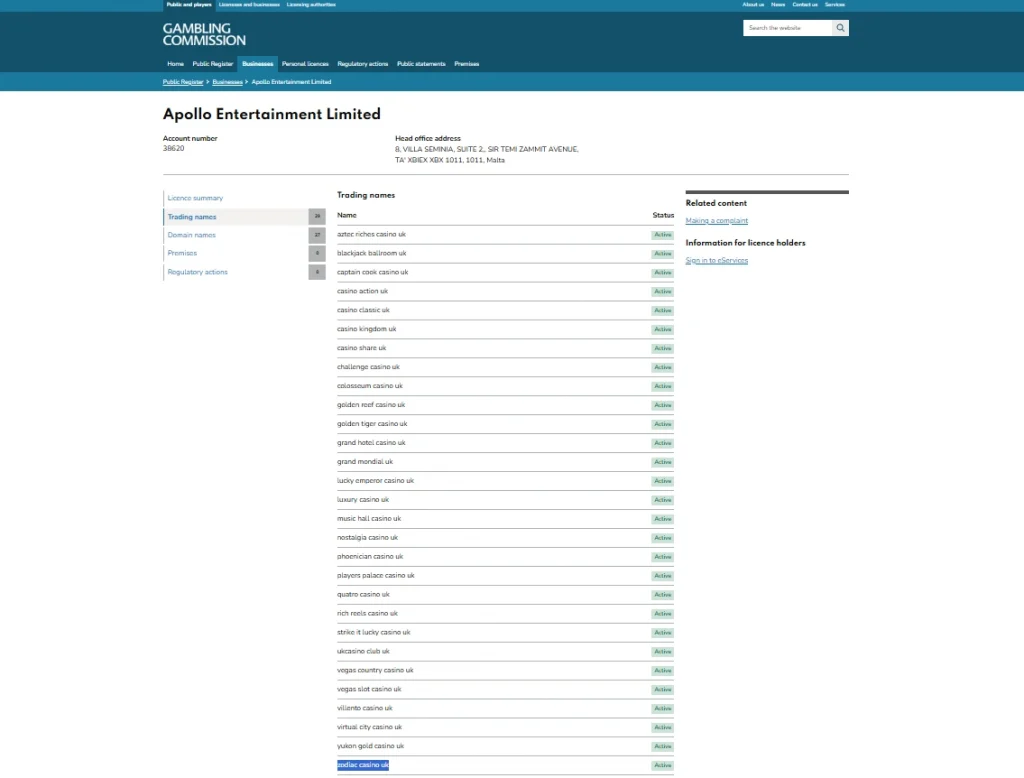
Zodiac Casino UK is managed by Apollo Entertainment Limited, and the current UK Gambling Commission public register lists account 38620 for that operator. The same register shows “zodiac casino uk” as an active trading name and zodiac-casino.co.uk as an active domain. Those are concrete identity and licensing facts that UK readers can verify themselves.
A register hit is useful evidence, but it is not a guarantee that every individual gambling session, withdrawal or support interaction will have a particular outcome. Licensing confirms the operator’s regulated status for Great Britain and brings the business within the Commission’s rules and supervisory framework. It does not turn a casino review into a promise of safety, profit or instant payment.
Table of Contents
- The UKGC record behind Zodiac Casino UK
- What a UK Gambling Commission licence does prove
- What the licence cannot promise
- Great Britain is the precise scope of the main UKGC casino framework
- Responsible-gambling controls you can check on the account
- Why self-exclusion and cooling-off are different tools
- Customer funds: understand the protection wording rather than assuming
- Support availability is useful, but not the same as regulatory evidence
- A five-step trust check you can repeat yourself
- How licence checks connect to registration and bonuses
- What the UKGC record tells you about Zodiac Casino – and what it cannot promise
The UKGC record behind Zodiac Casino UK
The regulator’s public business register identifies Apollo Entertainment Limited under account number 38620. Its trading-name page lists “zodiac casino uk” as Active, while the domain-name page lists zodiac-casino.co.uk as Active. The Zodiac website itself also identifies Apollo Entertainment Limited as the company managing the brand.
This three-part match is more informative than seeing a licence logo in a footer. It connects the legal operator, the trading name customers recognise and the web domain they actually use. A reader can repeat the check on the UK Gambling Commission trading-name register and the UKGC domain-name register.
The register currently shows the operator rather than a separate entity called “Zodiac Casino Limited”. That is why company-name verification matters: the consumer-facing brand and the licensed legal entity are not always identical.
What a UK Gambling Commission licence does prove
For consumers in Great Britain, an operator offering remote gambling needs the appropriate Gambling Commission licence. The Commission issues operating licences, sets licence conditions and codes, assesses licensees and can take enforcement action where requirements are not met. A current register entry therefore establishes that the named operator sits inside that regulatory framework.
It also gives you a public identity trail. If the casino domain you are using does not appear under the expected licensed operator, that mismatch deserves investigation before you create an account or make a payment. With Zodiac, the current domain and trading-name records line up under account 38620.
The licence also helps explain why age and identity checks, customer-interaction controls and responsible-gambling tools are part of the account journey rather than optional extras. The separate verification and KYC covers the account-level evidence Zodiac can request.
What the licence cannot promise
A licence is not a personal guarantee. It cannot promise that a specific player will win, that a withdrawal will arrive by a chosen date, that a support case will be resolved in the player’s favour or that no disagreement will occur. Those outcomes depend on account facts, payment processing, game results, terms and the circumstances of the individual case.
This is also why complaint anecdotes need careful handling. A positive review does not prove that every customer will have the same experience, and a negative post does not establish a systemic practice by itself. Complaints can be useful signals for questions to investigate, but the stronger evidence for operator identity and licence status is the regulator’s current register.
For payment-specific expectations, use the payment methods and withdrawal guides rather than treating licence status as a substitute for cashier terms.
Great Britain is the precise scope of the main UKGC casino framework
The Gambling Commission’s jurisdiction under the Gambling Act 2005 covers Great Britain: England, Scotland and Wales. The Commission regulates remote gambling offered to consumers in Great Britain and licenses businesses providing those services. That is the correct legal scope for statements about the Commission regulating ordinary online casino activity.
Northern Ireland is different. The Commission states that it does not regulate gambling activity there under the Gambling Act 2005 in the same way, because gambling is a devolved matter and Northern Ireland has its own framework under the Betting, Gaming, Lotteries and Amusements (Northern Ireland) Order 1985, as amended in 2022. Certain UKGC licensing and advertising rules can still be relevant to remote operators connected with Northern Ireland, but the domestic regulatory position is not identical to Great Britain.
That distinction matters on a site written for the United Kingdom. Saying “UKGC-licensed” is accurate for the operator record, but detailed legal explanations should not silently treat England, Scotland, Wales and Northern Ireland as one identical jurisdiction.
Responsible-gambling controls you can check on the account
Zodiac’s responsible-gambling material describes several practical controls, including daily, weekly and monthly deposit limits, cooling-off periods from 24 hours to 6 weeks, self-exclusion from 6 months to 5 years and hourly reminders of time spent playing. These are account tools rather than abstract policy statements, so the useful test is whether you can locate and use them when needed.
At the wider regulatory level, the Gambling Commission requires gambling businesses to maintain self-exclusion arrangements, and GAMSTOP provides multi-operator online self-exclusion for gambling businesses licensed in Great Britain. A GAMSTOP registration is broader than closing or excluding from a single casino account because it is designed to block access across covered licensed online operators.
From 30 September 2026, the Commission’s updated remote technical standards require gross deposit limits to be offered and reserve the term “deposit limit” for that type of limit. Zodiac’s existing limit tools should therefore be read alongside the terminology and technical requirements that take effect on that date.
Why self-exclusion and cooling-off are different tools
A cooling-off period is designed as a temporary pause. Zodiac’s current responsible-gambling information describes periods from 24 hours to 6 weeks. Self-exclusion is a stronger intervention for a longer period, and the operator’s material describes options from 6 months to 5 years.
GAMSTOP operates at another level again. It is a national multi-operator online self-exclusion scheme, so it is intended for someone who wants a barrier across licensed online gambling businesses rather than only one Zodiac account. The Gambling Commission states that gambling businesses must participate in the scheme and keep their excluded-customer lists updated.
These tools should not be collapsed into one generic “responsible gambling” button. They solve different problems: short interruption, operator-level exclusion and multi-operator exclusion. Knowing the difference makes it easier to choose the level of restriction that matches the situation.
Customer funds: understand the protection wording rather than assuming
Zodiac’s UKGC customer-funds disclosure uses the classification “not protected segregation”. That wording is important because a licensed casino does not automatically mean customer balances receive the same protection as money in a bank account or a fully protected client-money structure.
The practical lesson is to read the operator’s current customer-funds disclosure and understand the stated protection category before leaving more money on a gambling account than you need. Licensing and fund-protection classification answer different questions: one identifies the regulatory status of the operator, while the other describes how customer money is treated if the business becomes insolvent.
This is also a reason not to use a broad phrase such as “UKGC licensed, therefore your money is guaranteed”. The register verifies the licence record; it does not create a blanket guarantee for every customer balance.
Support availability is useful, but not the same as regulatory evidence
Zodiac says it provides 24/7 customer support by live chat and email. That can be valuable for account, verification and payment questions, especially when you need clarification on a request that is specific to your account.
Support statements should still be kept separate from regulator evidence. A support agent can explain the casino’s process, but the UKGC public register is the stronger source for checking the licensed entity, account number, trading name and domain. Similarly, a support response about a withdrawal does not override the written terms or payment-provider settlement process.
If your question begins with “who operates this site?”, use the register. If it begins with “what does Zodiac need from my account right now?”, use the official account and support channels.
A five-step trust check you can repeat yourself
- Open the UK Gambling Commission public register and search account 38620 or Apollo Entertainment Limited.
- Confirm that “zodiac casino uk” appears as an active trading name.
- Open the domain-name section and confirm that zodiac-casino.co.uk is active under the same account.
- Compare the operator identity shown on the casino’s own legal or verification pages with the regulator entry.
- Keep separate questions separate: licence status, account verification, customer-fund protection, payment terms and responsible-gambling tools each need their own evidence.
This method is stronger than relying on a badge image, a review score or a search-result snippet. It gives you a repeatable public check and makes it easier to notice if a future domain, operator name or licence reference does not match.
Repeat the check periodically if you keep an account for a long time. Regulator registers are living records: trading names, domains, permissions and operator details can change. An older review can provide historical context, but the current register should take priority when you are checking the status today. The same principle applies if you arrive through a new domain name or a marketing page that looks different from the site you used before.
How licence checks connect to registration and bonuses
The licence record does not tell you whether a particular promotion is good value or what current bonus terms apply. For that, use the bonus and promotions guide, which avoids presenting uncertain offer figures as fixed current terms. Regulation tells you who is operating and supervising the service, not whether a marketing offer suits you.
Likewise, the licence does not replace accurate registration. The registration explains Zodiac’s account rules and the role of identity data. A regulated account can still be restricted where required checks are incomplete or information cannot be verified.
Separating these questions prevents a common review-site mistake: using one positive licensing fact as a shortcut to make unrelated claims about bonuses, withdrawals or account experience.
What the UKGC record tells you about Zodiac Casino – and what it cannot promise
The strongest verifiable trust facts are straightforward. Apollo Entertainment Limited is the named operator, UKGC account 38620 is current in the public register, “zodiac casino uk” is an active trading name and zodiac-casino.co.uk is an active domain. Those checks establish the identity and Great Britain licensing framework behind the site.
Use that evidence for what it actually proves. It supports a factual statement about regulated operator status, not a subjective safety score or a guarantee of payouts, service quality or gambling outcomes. Combine the register check with the site’s account terms, payment rules, customer-funds disclosure and responsible-gambling controls, and keep the Great Britain/Northern Ireland distinction clear whenever legal scope matters.